Tuesday, September 16, 2008

Full Circle Is Underway!


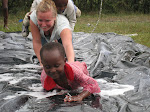
"WEENA, WEENA, WEENA!", the girls shouted as they jumped up and down erratically. They had just defeated the boys in a Tug Of War match. Full Circle, our holistic after school program, is underway! The program is designed to bring the concepts environmental conservation and nutrition into the lives of its participants.

Through games and hands-on activities, our kids (and most of the other boarders at Fikiria Kwanza Academy) will develop the tools necessary to start and maintain an organic garden, germinate and plant tree saplings, and they will learn the importance of the 3R's (reduce, reuse, recycle). 

Last week, we worked on developing leadership skills and emphasizing the importance of team work with Tug Of War. The kids were forced to work TOGETHER as a team to pull win their match, and their celebrations were impressive. Tug Of War was the official end Full Circle's first week, and I'd say we went out with a rather big BANG!

The program will last for twelve weeks, and thanks to the generous support of the Clif Bar Family Foundation, The Foundation for Tomorrow will be able to fund our ambitious projects! 

Upendo's Class Seven Graduation!!

Saturday, September 13th was graduation for Class Seven and Form Four from Usa River Academy. TFFT had one graduate from Class Seven, Upendo Estomi. The Tanzania Educational System has three different levels. The first is basic level which consists of pre-primary school (the equivalent of Preschool and Kindergarten) for Baby Class and Pre-Unit. The second portion of Basic Level is Primary School, which takes seven years to complete, beginning with Class One and ending with Class Seven. After the completion of primary school, students head onto Secondary School, which takes four to six years to complete depending on the capacity of the school. Most commonly, Form Four is the last year of schooling for the secondary level. The third, and highest, level of education is Tertiary when students will attend university or vocational training.

Usa River Academy put on quite the show for graduation! They hosted families and guardians on campus for a day-long celebration filled with music, dancing, singing, and speeches.


Upendo had requested a cake for graduation.. lucky for me (and the kids) I was able to find a couple boxes of Betty Crocker chocolate cake mix in town. I’m not so sure how I would have been able to pull off a cake for 32 kids from scratch. The three cakes turned out wonderfully – every last crumb and drop of icing was eaten by the kids.


While most were in good spirits for the day, there were a couple who didn’t seem quite themselves. Dickson Ephrahim and Dickson Simon, two of the most outgoing and attentive students in our scholarship program at URA, were not interested in spending time together with everyone or the cake. This really surprised me until I stepped back and put myself in their shoes. They had just sat through an entire day of graduation ceremonies, first of all, and then secondly they had to watch all of their friends and classmates spend time with their families, mothers, father, grandmothers, grandfathers, sisters, brothers, and cousins – the whole deal. I felt terrible once I realized what they were probably struggling with throughout the day and I can’t imagine how tough those days must be for our scholarship kids.

At the end of the celebration, Upendo packed up her things to head back to Good Hope Orphanage where she’ll spend her time until Form One begins next year. A couple of her friends showed up to graduation towards the end of the day and helped her with her things. Good Hope is about two miles up the same road as URA, so all eight of us piled into the TFFT car. As we pulled out of the driveway of URA, all of her friends started to belt out a song for Upendo. One of my favorite things here is how Tanzanians have a song, or make one up, for every occasion. It was the most amazing performance I think I’ve ever seen, maybe it was because we were all in such a small space and their voices were so powerful, but really I think its because it was so great to see her interacting with her friends, watching them give her support and congratulations for her huge accomplishment of graduating from primary school.


Wednesday, September 10, 2008

Homeopathy for our children

According to The World Bank
About 12 million young people between 15 to 24 live with HIV/AIDS
6,800 more people are infected with HIV every day! Almost half of them are under 25!
Young women are about three times more vulnerable to HIV infection that their male peers
2 million people died from AIDS-related illnesses in 2007
2.5 million people became infected with HIV in 2007
96% of infected people live in developing countries

Rosie and Rachel are more than just numbers, just part of the statistics, they are two of the sweetest, most humble, little girls. Last week my parents were here and I took them to FK to have a look around the library and to meet some of the TFFT scholarship students, when we walked into the class room, Rosie came up to me, grabbed my hand and lead to me to a sheet of paper on the wall, which ranked all the students for June, Rosie was number one on her class! I was so proud I wanted I cry!

HIV belongs to a group of pathogens known as retroviruses, which carry their genetic material on a single strand of RNA-rather than the double stranded DNA. It chooses White Blood cells as its host cell, on the lymphocytes surface they are studded with CD4 molecules. For HIV these act like a piece of Velcro and the virus binds to these molecules and forces it’s way in, commandeering the cell’s DNA, and replicates itself-one cell can produce 10,000 viruses. These burst out of the host cell, destroying it in the process, and look for more cells to invade.

Until Rosie and Rachel’s CD4 count is below 200 they are not eligible for ARV’s (anti-retroviral drugs), they are however susceptible to opportunistic infections. It is heart breaking when we take them to the dream clinic for their check up’s and blood work. It is heart breaking that treatment-ARV’s-are being rolled out so slowly, it is heart breaking that despite mother-to-child transmission being preventable, it wasn’t for these two little orphaned girls.
Yesterday I met with a Homeopath based in Arusha who mentioned Peter Chappell’s work in Ethiopia with HIV/AIDS, and the resultant remedy PC1(AF), which helps with appetite, breathing, weight, resistance to infection, and generally makes people feel better. It has been extensively tried on people around the world with AIDS, with marked evidence that the resistance to infection strengthens and the immune system is boosted. One great thing about PC1 is there are no side effects, as it is a natural remedy, and it requires low compliance. We have started Rosie and Rachel on it in order to try and boost their immune systems.

Sunday, September 7, 2008

Maths Education for Matonyok

9/8 –Well, another week has gone by and both the Teacher Training and the Matonyok projects have shown some progress.  First, I met with two different teachers who would be willing to offer critical analyses of teaching methods for those teachers selected for TFFT’s program.  This is important, as selected teachers will be spending time overseas in a new educational environment.  This environment will include new teaching models and ideas, and to accustom the selected educators for this experience, we’re planning on establishing a pre-departure training program where the Tanzanian teachers will be given feedback on their teaching methods and ideologies.  Hopefully, after this training, the teachers will not be that shell-shocked by the American teaching paradigms.  


Second, the Matonyok project is coming closer to signing a contractor for the sanitation unit.  I write ‘closer’ because I’ve met with the young man who Emmy, N’demno and I have all selected as our favorite, and we’ve already written an estimate for the job.  The next step is meeting with our lawyer to get a legally binding contract with him to complete the job by December, and within the budget.  I hope to have all of this completed by Wednesday.  


On a completely random note, I’ve begun teaching math classes at Matonyok twice a week.  For those of you who know my mathematic ability, this should be mildly amusing.  However, the class level III is learning multiplication, division, fractions (my favorite), decimals and other things that I didn’t think I would ever be teaching to a class of six.  Just goes to show you.  Either way, it’s a blast to get back in the classroom again after these long three months.  I’ll keep you posted to see if my tutelage is actually worth its weight in salt.  Happy second week of September, all!

Thursday, September 4, 2008

Henry-our TFFT dog!

Today I got a fright! I could not find Henry, our characterful little guard dog! I went every where, out side, up and down roads, asking everyone if they had seen a dog with a red collar-no, no, no! I was getting desperate, it reminded me of when Henry was kidnapped and a ransom of $50 was paid to get him back! After combing the streets, local dukas, and fruit stalls, I came home almost in tears only to find Henry in Alleys room eating Twizzlers looking very pleaseed with himself!

Back to School!!!

The third term of the school year started on Monday this week! Meaning that all boarding students were required to report back to school on Sunday afternoon. I spent Sunday driving all over Arusha (and surrounding areas) to pick up over 50 children and drop them off at Usa River Academy and Fikiria Kwanza. There are some guardians who look after the kids during break that are able to transport them back to school, like Mama Pendo from Nkoaranga Orphanage, which was a huge help!

I completely underestimated the task at hand when I began my day on Sunday. I realized that there are two very important parts to picking up a child - first locating the child and secondly finding their trunk of belongings (shoes, clothes, school uniforms, ect). I quickly learned that just because a child is at a certain location does not mean that their heavy, metal 4’ x 2’ truck is there also. So it was a great adventure with my limited Kiswahili knowledge to figure out with the guardians exactly where all of their things were. Some pick-ups were less chaotic than others, with the children all packed and ready to go as I pulled up. Mama Mike was a star, managing to get all 11 scholarship kids from her village waiting together on her porch with all of their things. I made other stops at Good Hope Orphanage, Patandi Village at Baba Juma's, Arusha Bus Stop, Matanyok, Tacoda Boy's Home, and Mama Nora's Orphanage in Makumira. In the end, after a lot of broken Kiswahili and hand gesturing, a few personal escorts in the car, and lots of radio sing-a-longs, all of our scholarship children (and their trunks) arrived safely at their school ready to take on third term.

Over the holiday, I had only seen a few of our scholarship students so it was wonderful to see all of their bright, smiling faces on Sunday. With each drop-off, I was able to witness the scene of each child’s arrival to FK and URA. The whole day seemed like a waiting game for the children, waiting to get to school, once they got there, more waiting for the arrivals of the other students not there yet. Anticipation was building with each passing minute they were patiently waiting so with the progressive arrivals throughout the day, the excitement and energy of the welcome scene only grew. The air was filled with hoots, hollers, shrieks, and shrills from the students upon seeing each other. It was a race to see would be first to embrace or give a high five, sometimes even tackling each other. I loved listening to their little mouths barking Kiswahili at each other, there’s just something so endearing about listening to a child’s voice, especially speaking a foreign language.

My heart melted over and over with this “welcome back” scene each time I brought a group of kids back to school. In previous months, I had noticed and recognized the bonds and friendships the TFFT students have made with each other but it was only made even more evident to me on Sunday. The genuine excitement, pure joy and happiness that exuded from their little bodies was really something special – their family was all back together again.

Monday, September 1, 2008

The Power of the Internet

9/1 – Well, happy September to everyone!  Last week was pretty chaotic, with people visiting from South Africa and our inter-web being down for about half the week.  It’s mildly disconcerting how much I rely on the internet for work, and this black-out period has really brought that unsavory fact home.  I forget how people dealt before the advent of such a time consuming tool?  Lots of snail mail and newspapers, I imagine. 

So, enough orating.  The last week of August has been productive, though not as productive as I would have hoped.  The contractor with whom I’ve been communicating on the Matonyok project failed to show up for a meeting late last week, which means that we might have to pursue a new course of action.  Unfortunately, many of our prospective contractors are either American or Dutch, and the Tanzanian government taxes non-natives some exorbitant rate which in the end will drive the bottom line of the project up quite a bit.  Something about native employment rates which, in the end, makes quite a bit of sense – since why would an NGO planning on helping Tanzania pursue ex-pat architects and contractors?  We still have yet a few contractors to contact who are Tanzanian and who will hopefully sign on to this project, but we need the structure built by December and fully functional by February.  

On another note, I was invited to a gathering at Matonyok on Sunday where members of the board of the Trust were trying to raise enough money for a new running water source – about 350,000 Tsh.  However, and what I found particularly interesting, was that they made a conscious effort to not rely on international support for the project.  Rather, they plan to raise the funds from within Tanzania, among their friends and neighbors.  This ‘ground up’ approach is something that I really haven’t seen among many organizations in the area, and I commend Emmy and N’demno on their perspicacity.  

Monday, August 25, 2008

Peace House

8/25 – Last week, I had the opportunity to meet with the Managing Director at Peace House, a secondary school that provides education for Tanzanian orphans.  Similar to the School of St. Jude, Peace House’s goal is to provide quality instruction to those members of the community who need it most – in this case, children who have been left orphans as a result of the HIV/AIDS epidemic.  

I was actually there to discuss some ideas regarding TFFT’s Teacher Training program, as the instructors at Peace House are Tanzanian citizens and have only vague notions of Western educational models.  I’m hoping to team up with the administration at Peace House in the coming months to develop some joint program for teacher education. 

By the way, the campus is amazing – state of the art and fully functional.  Right now, the school is providing free education for over 200 students – but the facilities can hold upwards of 800.  They currently employ 10 teachers but are looking for ways to revolutionize the caliber of teaching in Arusha over time, including the use of volunteer instructors and teacher swapping from the local international schools. Through this program, the Director hopes to create a sustainable environment for educating Tanzanian children for the future.  

Dream Clinic

AIDS

A disease that has ravaged sub-sahara Africa, infecting over 28 million people. A disease that has killed off older generations of Africans leaving behind millions of orphaned children. A disease that has stalled progress in educational, economic, and development sectors...

"A great many things made Africa particularly susceptible to AIDS, some of them innate to the communities where the disease flourished, and many other imposed from outside. The key factor is poverty. Put simply, millions of Africans are living with a virus from which they might easily have been protected if they had had access to education about it, or to the means of defending themselves... and the destitution and weakness of many sub-saharan states crippled their ability to respond once their populations were infected." - Stephanie Nolan, 28 Stories of AIDS in Africa


Before coming to Tanzania, I knew what HIV/AIDS was but it was never real to me. I had never been personally affected by the disease, I didn't know anybody who was or knew anybody who knew anybody that was - that's how far removed you can be from AIDS in countries like America. But in Africa, it's a completely different story. It is everywhere.

Support for International Change, is an NGO here in Arusha that provides free HIV testing, they were kind enough to come out and test our children. The Foundation for Tomorrow sponsors two little girls who are HIV positive, Rose and Rachel. Every month, they recieve basic checkups from doctors and every three months bloodwork has to be done to measure their CD4 levels. A CD4, Cluster of Differentiation 4, is a type of protein that is found on the surface of helper T cells in the bloodstream. CD4 acts as a receptor as HIV binds to the CD4 in order to enter host cells. The levels of CD4's helps to measure the course of HIV and treatment, when the level drops below 200 is when anti-retroviral treatment will be given to a patient due to minimal supply in Africa.

I had my first monthly check-up visit with Rose last week at Dream Clinic. Africa has its own concept of "time," even when it comes to having appointments. So Rose and I waited and waited for her turn. While Rose was happy drawing away in my notebook and eating the stash of lollipops I had given her, I looked around and watched every man, woman, and child there. There were about thirty people, some waiting for their appointments and others had come to attend an informational session. My heart went out to each one, wondering what their story was... how often do you come to the clinic? how long have you known that you're positive? how is your family? do you have children? are they infected?

The nurse called Rose's name and she strolled into the clinic like it was no big deal. Every doctor and nurse not only knew her name, but stopped to take the time and say hello. This visit happened to be time for a blood test but Rose was so brave. My heart was breaking, holding her hand as she tried not to look at the needle, her lips quivered, and the tears began to fall. Every child I have seen crying here is so much more dramatic than any other I've seen. Maybe its because their faces and cheeks are smaller and thinner? The tears just drop directly from their eyes down to the floor, they dont roll along the cheeks and it just makes the tears so much more profound. But Rose was strong and quickly recovered from the trauma of the blood test -
Rose's CD4 levels are good, for now at least.

I packed some popcorn for the trip, hoping it would help to ease any anxiety a doctors visit might provoke in her, so I broke it out for her after having her blood taken. A smile spread across her face as she took the popcorn and softly said asante. We had to wait a few more minutes to finish up in the clinic and as the other children spotted Rose with the bag of popcorn, they flocked towards her. She generously shared all of her popcorn with 7 other children, so much so that she only had a couple handfuls left for herself - that's just the kind of little girl she is.

Thursday, August 21, 2008