Monday, February 23, 2009

Hey Everyone - Here's the press release from the Matonyok Opening Ceremony:

--

Maasai Home Converts Waste to Fuel With Help of TFFT


Olasiti, TZ   Becoming environmentally conscious provides significant benefits to the Matonyok Parents Trust and the 27 children who live there. On Wednesday, February 4th over forty members of the Tanzanian and international community gathered in the Arusha district of Olasiti for the dedication of a state-of-the-art sanitation facility at the Matonyok Parents Trust. 


This facility was funded by the Hornig family of New York, USA and was built with the support of ‘The Foundation for Tomorrow’ (TFFT), an NGO which provides quality education for orphaned and abandoned children.  Among the ceremony attendees was the Founder and Executive Director of TFFT, Meghann Gunderman; the local US Embassy Warden for Arusha, Mrs. Ruth Edwards; Mr. Raphael Mollel, Ward Executive Office; Philemon Parshuku, member of Social Welfare; Ibrahim Mayo, Agriculture Officer; and the patrons of the Matonyok Parents’ Trust, Ms. Emmy Sitayo and Mr. Peniel Ndemno.


The sanitation facility took over five months to build and contains a bio-gas reservoir which will convert waste material to safe cooking fuel.  Also, included in the structure is a grey water reclamation system, which will provide the necessary water for the Trust’s recently planted organic garden.  To combat the rising cost of food, this garden will greatly reduce their reliance on outside vendors for food and will also teach students the importance of a healthy and nutritional diet of locally grown fruits and vegetables.    


The Matonyok Parents Trust is a registered Tanzanian charitable organization, and currently provides the necessary education, food, clothing and shelter for twenty-seven Tanzanian children.        


Monday, February 2, 2009

Going Clean

This month was the official kick off to our Term 1 Full Circle afterschool program. We spent the first week of school dividing into groups, choosing group names, which range from Tembo (elephant) to Manchester, and discussing what the kids would like to learn. The younger kids, as I suspected, are game for anything, while the older kids had some great ideas. This month is Go Clean, which has us focused on hygiene and how to take care of ourselves.

We've now covered how to wash our hands properly and how to brush our teeth. Both weeks have proved to be pretty successful and entertaining! It's easy to forget that our kids don't have anyone teaching them such basic hygiene outside of the aunties at school, who I imagine are pretty busy.

Add some singing, soap and fun in the water and you've got yourself a TFFT Full Circle afternoon. First the kids all learned a song that Lou and I made up in Swahili, telling them to wash the front, backs, middle (in between their fingers), nails and wrists. Then we had them sing the song while demonstrating their new hand washing technique individually for me. Of course we had breaks for biscuits and changing the water in the basins which added to the fun. However, I think they all walked away with a better concept of when, why and how we wash our hands!

This past week we learned how to brush our teeth properly. Again, we hit the songs, this time in English (to switch it up a bit). The kids had a great discussion about why it's important to brush their teeth (bacteria being a central theme here) with Lou and then they all got their own paper toothbrush to color. They wrote their names and "Brush 3x Every Day" on them and loved showing off their many colors.

We then had a "re-cap" day while the older kids were with the Support for International Change HIV Counselor that falls into their Go Clean curriculum. We're going to do a science experiment with eggs and vinegar to show what happens if we don't take care of our teeth (I know a little extreme) and make signs to hang up around campus reminding everyone to wash their hands and brush their teeth. Now we just need to cover feet, bodies, clothes and all the other dirty situations kids get themselves into!

Friday, January 23, 2009

Big Brothers & Big Sisters

The third week of term is coming to a close today and the TFFT children seem to be settling down from all the excitment and getting into their routines. The past few weeks have been dedicated to taking inventory of items the children are in need of (they range from sports shoes to school bags to blankets to hairbrush and so on), organizing and distributing all of these things, starting the after-school tuition, and establishing the Big Brother-Big Sister Program. I am especially excited and pleased to have the Big Brother-Big Sister up and running.


I took the foundational ideas from the Big Brother Big Sister Organization in the U.S. to create a much simpler version over here in Arusha for the TFFT scholarship students. I paired our children in the most compatible matches I could concieve based upon personalities, strengths, and interests to ensure success. I encouraged the older ones to spend extra time with their little brother or sister, to get to know them and help them in any way. I explained to the younger students that they had this "special friend" that they could rely on for advice, guidance, and help. Emily, Lou, and I worked to pair them all up in one afternoon and it was really something to see them all warmly welcoming this concept and each other. I was especially impressed with the older crowd, who within the first five minutes, were obviously taking their role very seriously and taking the smaller ones under their wings.

Vialethi & Rosie, Big Sister & Little Sister


Over the past two weeks, we have been able to see the benefit of this new iniative. The older ones have been keeping a watchful eye on the younger ones when we are not able to be around and have been actively seeking me out to talk about the progress of their little brother or sister. They have been working to help teach the younger ones to follow school rules and be well-behaved. This past week, I had two older brothers request a meeting with their little brother and myself regarding his behavioral problems. We sat down and had a peer mediating session on what the issues/problems were, why they needed to be improved, and how everyone felt about the situation. I sat back for most of it, as the older ones took the lead to explain the importance of respect, patience, and kindness to their little brother. They reminded him that they are here to help and they want to teach him but he has to be willing to listen. The whole thing was incredible and I could not have been more proud to see what was happening right in front of me. It was so amazing to see how much these children care about each other and that they are invested in each others growth and success. I'm really looking forward to seeing these relationships develop even more over the next couple months and the great results it will bring!

Some of our big brothers - Ombeni, Joackim, Amani & Simon

Wednesday, January 14, 2009

Lushoto

Well my first week back in Tanzania sure has been busy! The first part of the week was spent getting all of our TFFT kids back and settled at Usa River Academy. It was great to see everyone smiling and excited for school. I even caught a few fist pumps from some of them! Once everyone was settled, Lali and I headed out to Lushoto to see 2 of our scholarship children, Zawadi and Asha before their school year begins. After a quick detour to the Kenyan border (yes, we missed the only turn) and what we can only assume to be our granny driving, a short 6.5 hours later we arrived, only 2.5 hours longer than the intended trip.
Lushoto is beautiful. It’s a little town in the Usamburu Mountains, which are very green and very steep. Due to our detour, we arrived after dark and were met by Sister Ena who runs Irente Children’s Home. She showed us the Children’s Home Hostel where we would be spending the night, and after a little supper, we were tucked in our beds by 8pm. I guess the sisters aren’t really night owls. We started our morning by changing nappies in the baby room. I should actually say one of the two baby rooms. There are so many children it is overwhelming. One of the baby rooms held the older babies, and the other was lined wall to wall with cribs for the infants. This doesn’t include the rest of the children at the home who are older and occupied the other 4 rooms. We shared in Morning Prayer with the staff and a few little ones who had befriended us, before officially starting on our day.
Asha is still living at the Children’s Home when school is on break, so we were able to meet her right away. We spent time playing, and giving her some gifts from her sponsor. She showed off her ABC’s and 123’s and has the sweetest little personality. New clothes and stickers are bound to make any little girl smile, and Asha, who is still getting in some of her teeth was very excited. After receiving her gifts she went to change her clothes and come back out to put together a new puzzle with us.
(Picture)
Zawadi is living with a family over the holiday so we had to drive to see her. What a sweetheart! She is a little more timid than Asha, but some stickers, crayons and strawberry smelling lotion opened her up pretty quickly. Oh and a necklace that a little girl in Kentucky sent over with me. After a cup of tea and reviewing her report card with her new “family” we were off again.
(Picture)
We spent the rest of the day at St. Catherine’s Montessori school, the school the girls attend, getting all their business matters settled. Then a quick trip to Irente Farm for some homemade juice and bread before having a late lunch at Irente Children’s Home and getting back on the road! Detours were avoided on the way home, though the driving didn’t speed up too much, but I’d say all in all, a great little safari.
-Emily Cottingham

Tuesday, January 13, 2009

New Year, New Projects


First off, hopefully this post finds you enjoying the New Year. The Foundation For Tomorrow programs, as in the past, have shown considerable progress over the past month. Matonyok is nearly completed (at least, it was nearly completed when I left for Zanzibar) so I can only assume that the doors have been put on their hinges and that the window glass has been installed. Ndemno, true to form, has been overseeing the entire construction process and has been able to save some money by cutting corners and explaining the facility’s function to a few of the local contractors and hardware supply stores, who are keen to offer better prices for the construction of a sanitation facility for local orphans, while using material purchased from local merchants.

This, I think, really helped in the construction process. By visiting the shops, speaking with the owners, establishing trust, walking twice weekly through Olasiti – the people saw that TFFT wasn’t just throwing money at the project so that it was completed as quickly as possible. Taking an active interest in the construction process helped me to understand the various steps that were taking place, as well as the structured need for materials – that is, when each of the materials would be needed given their purpose in the overall building. I’m really now looking forward to seeing the completed building, and setting up the opening ceremony (more on that later, hopefully we won’t have to slaughter a goat!)

Teachers’ Training has taken a hiatus, since the schools are also on break. However, once the new scholastic year begins, I’m going to focus all of my attention on getting an affiliate school. From there, the program has been established and is waiting to be implemented. However, I’ll of course go back and try to trouble-shoot any unanticipated issues. But, I feel as though this program is stronger and – regardless of the timeline – will be better for the Tanzanian educational system as a whole.

The Organic Gardening Initiative proposal has been written and is just awaiting delivery. Right now, we’re trying to have a local vegetable center offer classes for the children at Matonyok, as well as oversee the implementation of advanced farming techniques over the course of the year. However, Emmy proposed the idea of having AVRDC come to Matonyok and address not only the children and the patrons, but also offer a class for the surrounding areas for farmers who can take advantage of the progressive farming techniques that AVRDC will introduce. This way, the classes can benefit not only Matonyok but the entire surrounding area as well.
So that’s all I have for this week. Hope all’s well wherever people are reading this and that the New Year is already better than the last!

Friday, January 9, 2009

Back To School We Gooo

Emily and I spent this past Sunday collecting all the children for the start of the 2009 school year. The day was as hectic as ever but everyone has arrived safe and sound at Usa River Academy, ready to go for a new school year! All of the students within the TFFT Scholarship Program, with the exception of Asha and Zawadi in Lushoto, will be attending Usa River Academy. The decision to move all of the children into one school was made with their best interest in mind and we are looking forward to a very successful 2009 school year!

Fikiria Kwanza students are joining past Usa River Academy students and it has been a smooth trasnition thus far. The new students are so excited to be at Usa River and are having a blast discovering all the new things about their new school and the other 32 TFFT students there. Most were surprised to learn that there were other TFFT students outside of their respective schools, so it will be great for everyone to be together at the same school this year.

This week I am working to get a Big Brother, Little Brother & Big Sister, Little Sister Program up and running for the children. I will be pairing an older TFFT student with a smaller one in the hopes of bringing them together and creating a greater sense of community within the students. The older students will be a source of leadership, support, and stability allowing the younger ones to look up to them for help and guidance. I believe creating these connections between the older and younger children will have a great positive impact on their education and development as well as the transition of new students into Usa River.

We are looking forward to continuing the Tuition Program as I have seen great results within the students over the past couple months. They have been working very hard with tutors and teachers after school to raise their grades and with great success! Most students working within the Tuition Program have brought their grades up in individual subjects as well as their overall grade averages. They are all very pleased to see results of their hard work and have already asked if we will continue to assist with Tuition this coming school year. I am so proud to see their hard work and dedication paying off as well as their eager attitudes to begin tuition again this year.

Wednesday, December 17, 2008

Traveler's Philanthropy Conference Dec 2008

Two weeks ago I attended the Traveler’s Philanthropy Conference www.travelersphilanthropy.org here in Arusha. The Centre on Ecotourism and Sustainable Development (CESD) www.ecotourismcesd.org hosted the three day event, in Arusha at the Ngurdoto Mountain Lodge. At the core of Travelers Philanthropy (TP) is the idea of “giving back” of time, talent and treasure to tourism destinations, with Arusha being the gateway to Mt. Kilimanjaro and the Northern Safari circuit in Tanzania, it provided an ideal venue! TP is slowly gaining ground as an important form of development assistance flowing from tourism businesses and travelers into projects that support local communities, our focus however, was on giving a hand up rather than a hand out.

There were two key note speakers:
Nobel Laureate Wangari Maathai, Ph.D.
Maathai founded Kenya’s Green Belt Movement http://www.greenbeltmovement.org planting over 40 million trees and becoming a leading force in Kenya’s pro-democracy struggles. In 2004, when Dr. Maathai was awarded the Nobel Peace Prize for her efforts, she became the first environmentalist and only African women to receive this prize!

David Western, Ph.D.
David Western is the former Director of the Kenya Wildlife Services (KWS), and founder of the East African Conservation Centre http://www.conservationafrica.org and founding President of The International Ecotourism Society (TIES). Western’s particular interest lies in pastoralism and community participation in conservation.

I attended a number of different workshops, from “the rights and wrongs of Philanthropy” to “Using the internet and media to promote and solicit donations”. What came up again and again was the need for community ownership, and the importance of the process of engaging with the community.
One company that stood out for me was The Intrepid Foundation www.theintrepidfoundation.org, which highlights the importance of income generating projects, to foster empowerment, and develop self-reliance. This I believe the first step towards TRADE NOT AID.

Wangari Maathai’s Key note speech was focused around the need for sustainable management of our limited resources, and the promotion of equity in the distribution of those resources through good governance. Very much tied into this is the culture of creating capacity and to what extent an organization can answer the question-has your project empowered a community? To what extent are we creating ownership? So that we can move from dependency to becoming a partner in development, where there is no sense of entitlement in the relationship.

For me one the most interesting workshop was about moving from Charity to Social Empowerment. The speaker that stood out for me here was Trisha Barnett from Tourism Concern, UK, http://www.tourismconcern.org.uk
who again highlighted the need for community empowerment, but not through Philanthropy or aid, but through trade, ethical tourism and enabling entrepreneurship.

I took a great deal from & Beyond (formerly CC Africa) http://www.ccafrica.com about the importance for working with communities and not for them. Accepting that respect takes time, relationships need to be nurtured.

How does all of this relate to TFFT and the valuable work that we do with orphans? I have a few ideas that I came up with from the conference:
Full Circle After school Program: Have the older children tell us what they think they need to learn , and what they would like to learn after school!
Developing an income generating project, that empowers our students and teaches them the basic principles of running ones own business.

Friday, December 12, 2008

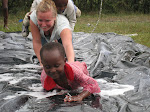
Feeding Table for Nkoaranga Orphanage


Nkoaranga Orphanage, a partner orphange of The Foundation For Tomorrow, has recently received a very useful and helpful donation from the Bianucci Family. The Bianucci family spent some time this past summer volunteering at Nkoaranga Oraphange and helping out in any way possible. They have become very involved with various projects to help improve the facilities and way of life at the orphanage.

The Bianucci's realized the need for a safer and more managable approach to feeding time. On an average day, there are two to three Mama's working at the orphange with the 25 children, all who are under the age of five. As you can imagine, every day is quite an adventure... especially when it comes time to eat. The older children have got it down, they all sit at the miniture table in their miniature chairs and are able to feed themselves for the most part. You will have the occasional fast eater who will have finished their own food and try to snatch someone else's but for the most part it all goes pretty smoothly. The infants and toddlers are were it gets a little tricky. There are 8 of them right now and with only a few adults, there aren't enough arms for everyone to be held and fed at the same time. The orphange does have some smaller high chairs for this age group; however, they tend to be a little topsy-turvy.

After a visiting Cradle of Love, a local orphange for infants to two year olds, the Bianucci's had the perfect solution. Cradle of Love uses a feeding table for all of their meals and it works brilliantly. I arranged for ADRA, an organization working on a variety of development projects across Tanzania, to build the table for us - they did an awesome job! The table is high off the ground and shaped like a horse-shoe, allowing for the Mama to stand in the middle to easily reach all the children facing her. The table holds 6 children at a time, who are all securely seated in individual seat holders from which they can't fall out or escape from. It has been an amazing addition to the orphange, everybody seems to be really enjoying it....


Mama Pendo serving lunch


The boys hanging out & loving the table


Thanks so much to the Bianucci family for this generous donation!

Thursday, December 11, 2008

December is Hot in Tanzania

December 11th – Not that the title has anything to with this blog, but it’s been a busy past two weeks here on the ground in Tanzania (notwithstanding the fact that it really is just really hot in Arusha right now). Starting at the end of last week where TFFT exhibited at the Traveler’s Philanthropy Conference hosted here in Arusha, there’s been a lot of busy work to be done (including having a banner made post haste and printing out some pictures of the kids to decorate our stall). While there were some very interesting people presenting – including Wangari Maathai who received the Nobel Peace Prize in 2004, in part for her work founding the Green Belt Movement which plants trees to combat soil erosion – I can honestly say that a majority of the stalls were focused on selling kitsch to the visiting conference attendees. In one case, a Tanzanian man asked me if he could get a job with TFFT – though he hardly knew what we did. Then, when I informed him that there were currently no positions open here in TZ he seemed completely baffled, spelling out the name on our banner saying “This is ‘the Foundation for Tomorrow’, right? Well, what about my tomorrow? Aren’t you concerned with my tomorrow?!?” Mayhaps we should change the name of our foundation to ‘the Foundation for This Particular Guy’s Future’ (TFFTPGF).

Then, on the Sunday after the conference I was invited to attend a baptism ceremony for Emmy and Ndemno’s granddaughter Deborah, as well as for Omari – a worker at Matonyok who converted from Islam to Christianity. Technically, I was invited to the party after the actual ceremony – but it was quite the experience nonetheless. Imagine – a tent in the middle of the brush, Omari, Omari’s wife, and Deborah at the head table all dressed in their Sunday best. Then the Matonyok gang all done up in matching orange and white baseball shirts, singing and dancing all the while. Then Omari’s (though now called Emmanuel) extended family, occasionally ululating whenever someone took the podium to extol Emmanuel’s virtues. Let me tell you folks, Emmanuel’s grandmamma can really cut a rug even though she must be upwards of seventy years!

It was quite the experience and one which I can honestly say was unlike anything I’ve ever witnessed. Between the boldly colored dresses, the dancing, the singing, the cake – there was an almost palpable feeling of community to this occasion. One quick note about Tanzanian parties in case you ever find yourself attending one. Whenever there’s cake, the person for whom the cake is made is served last. In fact, the quest of honor is obliged to feed everyone else before he or she can even begin thinking of chowing down on some cake. So make sure to get your cake beforehand if someone throws you a party here in TZ. That’s all I have for this Thursday. Hope everyone’s looking forward to their respective holidays (though, yes I know that Ramadan has already past – BUT Eid al Adha has just taken place, so that counts).

Monday, December 1, 2008

December!

12/1 – Hello everyone and happy December. I must apologize for my delayed blogging… I’ve been through about three computers this month as well as two power bricks and all of this technological difficulty has taken its toll on my ability to write for an extended period of time. So here it is.

As always, Matonyok is proceeding nicely. Aside from the workers’ wages and some incidental materials that seem to always pop up at the end of a construction project, it looks like the sanitation facility will be completed under budget and close to two months in advance of schedule. I say this as the short rainy season begins, but the roof has been up for about three weeks and has already weathered some heavy storms (most notably last Friday night where it rained torrentially for close to three hours. The local authorities advised people with goats and sheep in their yards to take them all inside, as the rain might be too much for them to handle).

But the structure held up and should be good to go. The electrician has already come and gone, and the plumber is back this week to connect the bio-gas tanker to the sanitation facility. After this, there should be only minimal work to be done – though the electrician has left wires available for the installation of a solar panel system (more on that later).

As this project comes to a close, I can’t help but look back at the expediency with which the workers executed their responsibilities. Everyone, from the timber man to the hardware store to the electrician to Emmy and Ndemno have been completely dependable and have worked diligently to see this project to its conclusion. I now know that since I’ve put it in writing that something will come up. But we’ll deal with as best we can, as always.

It’s actually been a busy month for teachers’ training. Beginning with meeting with the US consulate staff in Dar in early November, the wheels have really got going – and I think that going back to the drawing board and reinventing the program is a great idea. I’ve been able to meet with some leading educators in Arusha, and they all agree that working on a smaller scale closer to home is a much better idea (and much more marketable since it undercuts the need for six $3,000+ flights to America) and some have even advocated keeping it within Arusha, while working with the international schools. But I’ve been able to get some contact and have gone back to revise the proposal time and again. It’s currently known (rather aptly) as ‘Work in Progress’.

However, I’ve gotten some good feedback and will have something tangible to offer by mid-December. Even if we start the program in early February, there’s still much time to work out the kinks and select motivated teachers from our affiliate schools. Most recently, I met up an ex-pat who operates a teacher’s college in Magugu (yes, that’s a real place) and has been a great help on this project. She thinks that it’s a much better idea to streamline the program to include only one academic field per year – starting with maths, then science, then English and so on for an extended period of time.

Needless to say, there’s been a lot of editing and re-editing which I believe is for the best, since I’d like the program to be implemented as effectively as possible. Though, there’s still the question of quantifiability – something that I’m currently working on this month. So, that’s all I have for now. If you’ve gotten this far, congratulations! I’ll try to be more diligent in writing.