Tuesday, August 19, 2008

A Bit More from Matonyok

The Foundation For Tomorrow has a big job helping a handful of special kids.
As I noted in my last blog, the children at Matonyok don't have any real shower or bathroom facilities on hand. Rather, the bathroom consists of a hole in the ground surrounded by four posts enclosed with plastic sheeting, which provides only very minimal privacy. For washing, the children fill buckets with warm water and clean themselves early in the morning or late at night to prevent being seen by other children while bathing.

In both cases, there is no running water and the risk of communicable disease is high. Also, because the children wash themselves so early in the morning and late at night, there is an issue of safety – as wild animals (including snakes, which have been seen on multiple occasions behind the bathroom facility) and insects can harm the children. I really wish i could upload some pictures to show you just what the facility looks like, but unfortunately the internet right now is ridiculously slow and I can't even post a thumbnail.

Anyhoo, that's all from my neck of the woods. Postings to come...

Tuesday, August 12, 2008

August 6th - This week, I’ve been spending quite a bit of time at the Matonyok Parents Trust – an orphanage that provides a structured environment where some of the area’s neediest children can come to learn. Since the term ‘matonyok’ come from a Maasai term meaning ‘struggling very hard together’, there is little wonder that the directors – Emmy and Ndemno Sitayo – are working hard to provide quality education for Maasai children who have been neglected or left parentless for whatever reason. In particular, the Trust hopes to educate Maasai girls to not only offer them a better quality of life, but they hope to end the brutal practice of female circumcision and prearranged marriages that currently is part of the Maasai culture – at least among the students that attend classes at Matonyok.

Both Emmy and Ndemno have committed their lives to helping children. Emmy, a nurse by training, would visit the remote countryside to offer her services to developmentally disabled Maasai children. It was then that she realized the need for a more comprehensive center where these children – as well as orphaned children – could come to learn in a supportive environment. Opening their home at first to one child, Emmy and Ndemno now have thirteen children living with them in their two-roomed house – as well as seven children who come from the surrounding areas to attend classes at Matonyok. It is both Emmy and Ndemno’s hope to build a learning complex where they can educate fifty children a year, thereby improving the quality of life for some of Tanzania’s neediest children.

TFFT is working with Matonyok to take the first step in this dream. By upgrading the sanitation facilities (which currently constitute four posts in the ground surrounded by plastic tarp), we hope to have built a fully functional shower and bathroom facility by February 2009. This will help not only to raise the level of hygiene among the children at Matonyok, but it will also help to prevent communicable diseases – as there is currently no money in the Trust’s budget for emergency medical attention.

posted by T.C.

Our Organic garden at Fikiria Kwanza

The sun emerged from behind the clouds for the first time in weeks on Thursday. Mount Meru flaunted its peak for Wazungu and Watanzania alike. Alley and I marveled at its impressive size, and realized how fortunate we are to be living in such a beautiful country.

That day, we were on our way to Fikiria Kwanza Academy to do what I like to call “my first effort at manual labor”. TFFT is partnering with the school to start an organic garden, which will yield enough fruits and indigenous vegetables to supplement the basic rice and beans diet of all of its students. So, on this day, I approached one of the school’s groundskeepers and asked, in my weak Swahili, for two hoes, a bucket, and some assistance.

The trek from the main campus to the garden is short, but filled with wonder. You walk through Fikiria Kwanza’s crop of coffee plants, pass under tall trees that house frightening birds, and avoid stepping onto the hills of some of the most vicious ants I’ve seen to date! The path winds briefly through this wildlife and spills you out onto a dirt road that runs parallel to the campus grounds.

We spent hours hoeing the designated area for our garden, and with the help of some of Fikiria Kwanza’s gardeners, were able to brush up on our language lessons. The garden should be ready for planting by the beginning of September, and yielding foods within a few months. We can’t wait to see what the cooks at Fikiria Kwanza do with the variety! Until next time…

T.D

Tuesday, August 5, 2008

Saba Saba

July 7th , “Saba Saba” is a national Tanzanian holiday which celebrates the founding of the Tanzanian political party, Tanganyika African National Union (TANU) in 1954. Being a national holiday, school is out for the day so we decided to do something special…

we brought the great American summertime tradition of slip-n-slide all the way to Fikiria Kwanza Academy!

Meghann inspired this brilliant idea and Adelaide and I went off to the main market in Arusha Town to see what supplies we could throw together for a home made slip-n-slide. We managed to discover thick, black plastic sheet that was at least 10 meters long. The vendor's insisted that we stretch the plastic out to its entirety throughout the bustling market scene to inspect its quality – once again making us the crazy wazungu! We made our purchases of the plastic sheet and laundry soap and took off to Fikiria Kwanza.


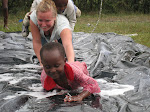
More than fifty very confused and hesitant little faces looked onwards as we found the hose, spread out the plastic sheet, and started soaping up the surface. Lali managed to explain the concept of slip-n-slide but they still needed some serious encouragement. I selected Mandu from the crowd and egged him on. As soon as he took off down the plastic sheet, the other kids were quickly stripping down and racing over to the top of the slide for their turn.


The grounds of Fikiria Kwanza lack the ideal hill spot for a slip-n-slide so it was absolutely hysterical to watch each child make their way down the sheet.

A few decided to run only to find out they will hit the ground fast, and hard, with all the soapy suds; others would bellyflop; some found army crawls to be their favorite; and the littlest ones would lay flat on there stomachs with arms and legs outstretched patiently waiting for someone to give them a big push down the sheet. Even after most of the kids were having the time of their life, we had a few like Rosie and Namayani who were lingering on the sidelines. We didn’t take no for an answer, knowing that they just needed a bit more encouragement to join in on the fun, and had almost everyone slipping and sliding.

I was surprised at how organized we managed to keep the children although there were a few times that chaos took over and every single child piled onto the slip-n-slide and each other, squirming and wriggling about. I think it’s safe to say that slip-n-slide was hugely popular and will be warmly welcomed every time we break out the supplies from the trunk of our trusty Subaru.


Monday, August 4, 2008

Prize day at FK

On Tuesday 29th July we all went along to FK school to witness their first EVER prize giving at the end of term. When I arrived I was asked to be guest of honor and help present the prizes to the kids who had done well in school, improved the most and been the tidiest! It was such fun! The best bit was when Nicemary and Matayo received prizes as the whole school erupted into applause and wolf whistles! Good to see that our TFFT kids were the most popular in school! We then went up to the board house and helped get the kids organized for being picked up, we filled our car with metal trunks and kids and drove them up to Mama Mikes. She is such a star, and her chai is arusha famous!

It was heart breaking however to have to leave the triplets and Stefano at school, I remember the end of term and the excitement of watching every car come into the school and the disappointment that it wasn’t mum, this is 10 times worse as mum is never coming, they were in floods of tears, it was awful! We need to find them a home, but taking on three children is a lot to ask, and we do not want them split up…so yesterday after lunch we went to pick the four of them up and brought them home-it was chaos! We colored in, we played ball outside, we cooked up a feast, played ‘Go Fish’. Poor Yusufu ate so much that he felt sick! It was like Christmas in the TFFT house!

Friday, July 25, 2008

Jessie's Blog

On Thursday morning our motley crew of 7 woke up bright and early at 3 am to get going on our very own safari! Our trip was intended to scout out the route for our Ride Tanzania bike trip. The charity and service bike trip, which follows the old slave and ivory trade route, will bring awareness of the issues Tanzania faces with education and child slavery. TFFT believes that education will mitigate child protection issues. We had prepared by the trip by stocking up on water, oranges, nutella, Pringles, and candy! We all piled into the car ready for a long day of driving. It was freezing as we set off on our adventure - 5 girls, Kapanya our guide, and Kitcha our silent driver. We soon discovered that the back seat of he car was incredibly uncomfortable and sloping in such a way that our butts were numb in less than an hour! Day one we had hoped o make it to Nyakanyazi, however we soon realized that this was a stab in the dark, as soon enough we encountered a road block where trucks were lined up in a gridlock and no one was moving while men shoveled gravel out onto the road. We decided to take a detour through the "countryside" but we soon discovered that our radiator was leaking, we were lost, and our was smoking as it overheated. This meant that we had to stop every 20 minutes to find water and fill the radiator; luckily we managed to find little homesteads with water. It was a long day! We eventually arrived in Singida with sighs of relief - 15 hours after setting off! We found a mechanic who claimed he was able to fix our radiator and we set off on foot to find some food. We found food in a small little shack on the side of the road, where we ate Wali maharagwe (rice and beans) - my first truly Tanzanian meal! Little did I know hat this would become the staple in our diet for the next week. After our meal we settled into Osaka Garden Hotel. I was on the floor, whilst Alley and Adelaide got comfy in the bed. There was a baby cockroach but we pretended to not see it. Meghann and Lali were asleep by 6pm, ready for another 2:30 am wakeup call!
 
The next morning we woke up again bright and early and set off to Nyakanyazi. However we soon realized that our car was not fixed and still leaking. As we stopped on the side of the road for a quick fix-up we saw an enormous baobab tree with a makeshift ladder next to it. It was incredible! Soon after we got back into the car and stopped a small town and ate wali maharagwe (what else?) as our car was at another fundi (mechanic). Once our car was "fixed" we were back on the road until our radiator started to leak again! A bunch of kids came up to our car with the most incredible wooden bicycle equipped with springs and pedals! True ingenuiy! Even though Lali almost broke it, we rode around on it - practicing for the trip. It became clear that our car was a lost cause for the night, so we got a lifty from a nice family through a Lutheran church and they dropped us off in Kibondo while attempting to tow our car. we spent the night in Kibondo as our car was yet again at the fundi. After eating breakfast (some dirty cassava) we got back into our car and drove to Kigoma and Ujiji. Although the car ride was only supposed to take 3 hours, after 7 hours in the car we finally made it to the beginning of our scouting trip! After eating even more wali maharagwe we woke up the next morning to begin our mission. 
 
In Ujiji, we visited the Livingstone monument where we learned the facts behind the phrase "Livingstone, I presume" from the guide with a most hilarious voice! There we met two South African UN workers, who kindly told us to visit Jakobsen beach on Lake Tanganyika followed by joining them atop their UN Hercules cargo plane for sundown. It was a great start to Kigoma and Ujiji, truly a once in a lifetime experience. Our first day in Kigoma and Ujiji went well - we scouted hotels, conference rooms, and welcoming areas for the participants of the bike ride. After a fun filled night with our new UN friends, we woke up the next morning to meet with district commissioners and educational officers. We visited both the Kigoma municipal and Kigoma rural districts and learned a lot about the needs of Kigoma's educational system. Even though we caused some havoc by breaking a table, the officials we met with in Kigoma were happy to allow us introduce TFFT, and make connections for the trip. Our plans for town-hall type meetings with community members and officials of Kigoma seem a definite possibility! After our meetings, we visited the Kigoma public library - a small but filled library with over 400 members, very promising but with a population of roughly 130,142, access to books could be eased somehow and without cost to the community! After watching the sunset on beautiful Lake Tanganyika, Adelaide, Meghann, and I spent our last night in Kigoma and woke up at 5 am to make our trip to Tabora.
 
Tabora, founded in 1820 by Arab Slave Traders was once a major trading center along the old caravan route connecting Tanganyika with Bagamoyo and the sea has an important role with both education and the history of the slave trade route. The infamous slave trader Tippu Tib had his headquarters there, as it was once the most populated and prosperous town in all of East Africa. It also gained prominence as a regional education center, a reputation that has managed to retain itself today. The "Father of the Nation", Julius Nyerere attended school there.

After staying one day there, we traveled another 8 hours, north towards Arusha, landing ourselves back in Singida. Thankfully everything worked out and somehow we arrived in Arusha a couple days later and in one piece! (The car definitely did not, though). Full of wali maharagwe, baked beans, corn from the can, and more dust than one could ever imagine, we were glad to be at our home in Arusha! Although the trip did not go according to plan, it was a true safari! We learned a lot in Kigoma and definitely began making some important connections TFFT has now introduced its name into different parts of Tanzania, and can hopefully expand into these areas one day in the near future! The bike trip will definitely be an adventure next summer, and we cannot wait. We had a great time, but I dont think the 5 of us girls will ever eat wali maharagwe or get into the car we drove again!

Wednesday, July 9, 2008

Gardening in TZ

June 26-27, 2008

A group of us from TFFT participated in a two-day seminar at the World Vegetable Center, right here in Arusha. We arrived to meet up with thirty other matrons and mamas from the local schools and orphanages we work with. The morning began with classes on different types of roots, fruits, vegetables, and seeds and the nutrients they supply. Although we were surprised by the Swahili-only lectures and directions, some of the mamas helped translated for those of us that needed it. Around midday, we were split into groups for some hands-on cooking. Each group prepared a different type of organic dish from various vegetables such as sweet potato leaves and cowpea leaves. After cooking and cleaning, everyone’s dishes turned out pretty well and we had ate them at lunch. The rest of the day we spent in the garden learning about different ways to plant and different types of seeds. After a long but very informative day at the Center, everyone seemed excited to learn more tomorrow.
We started out the following day with classes on the drying and storing indigenous vegetables and fortunately the instructions were in English. The cooking portion of the day covered recipes all involving tomatoes. My group made tomato paste, which turned out to taste better than the store-bought sauce. Others made tomato jam, ketchup, and tomato chutney. These were all surprisingly easy to make! After cooking and lunch we spent the afternoon composting- a much more complicated process that you would think. A successful compost pile involves of 10 layers of different matter. We ended the day with a bag of various different types of seeds and a green certificate of completion. Hopefully all the mamas and matrons will bring everything they learned back to their respective schools and orphanages to start up some organic gardening!
This past week has been amazing, a week of learning, of growing, of being present. I have been working on the new after school program "Full Circle" which will facilitate progressive social change through our children's exposure to and appreciation of the benefits of environmental restoration and conservation, healthy lifestyles and creativity. On the way to FK I always drive past a sign for "The World Vegetable Centre" how could I not be intrigued?! So I finally called them up and went to meet the lovely Dr. Mel - we now have a partnership! http://avrdc.org/. Last week 30 of our staff, teachers, and mamas from our partner orphanages learnt about Vegetable Home Garden Production Techniques (using Organic Gardening approaches); Preservation, and Processing of Vegetables. New recipes were introduced in such a way that nutrients are preserved and bioavailability enhanced. After the training, each participant received a pack of seeds with 14 indigenous vegetables - enough to feed a family of 10 for a year to set up their own gardens. This was our first step in trying to promote nutrition, and decrease micronutrient malnutrition! As part of our "Full Circle" we plan to set up a huge organic vegetable garden, and have a school full of green thumbs. It has always been a dream of mine to set up a fully functioning organic garden, as growing up one of my favorite things was being able to pick my own vegetables, and spend time in the garden.

My second mission of the week was to find an art teacher to help us introduce creativity into our children's lives - creativity with a theme of "Go Clean", promoting recycling and reusing local materials. Today I met with an incredible lady, Linda, from the Umoja Art Centre, who is putting together a phenomenal one month art initiative which will involve an introduction to drawing, painting, and constructing 3-D pieces for us to follow at school! So it seems Full Circle is almost complete.

TFFT also had the great fortune of being donated Henry, our new dog! He is divine, so naughty, full of character and a great asset to our team! Thank you to the Roots n' Shoots ladies!


So our life out here is full, we love having Meghann, Adelaide, and Jessie out here to help out this month.

Wednesday, April 2, 2008

They were all out at Fikiria Kwanza Academy on Monday, dressed for success and ready to celebrate the opening of the brand new library financed and built by The Foundation For Tomorrow in this, our first year on the ground in Tanzania.

Mandu was lookin' sharp.


Helena was looking radiant, as always.


And the MC was lookin' straight up Superfly.


Have you ever been to a library dedication in northern Tanzania? Not even that; have you ever been to a baptism, a wedding, a confirmation ... anything where they have a catered, sit down meal?

For the members of the TFFT board and their relatives who were in attendance on Monday -- as well as for our videographer Justin and a potential future employee Lali, whose mouths dropped to the floor when the "cakie" came rolling down the aisle -- dessert was a pretty shocking surprise. That is because their respective answers to that question would be "No." Hunter and I, practical Wabongo weupe after nine months of living in TZ, would say "Yes." That's why the main event of the pre-ribbon cutting ceremony hardly raised a ripple for us. We're keki veterans.


"Cakie" is a euphemism for goat.


Goat is actually pretty tasty, if you don't mind the salt. Or the hooves. Or the fur. Or the look of absolute anguish stuck on its face as it breathed its last breath on earth. Or red cabbage stuffed into its mouth to add aesthetic value, an almost comical attempt at distracting us from what the red cabbage is stuffed into. I personally am not bothered by it, because of how much I love Elton John. "It's the cirrrrrrrcle of liiiiiife!" right? Even so, I don't see myself ever making the transition from flour, sugar and eggs to the flesh of a domesticated animal for celebrate-good-times-come-on food.

It seemed at times like it would never happen, the end of this project. So it feels great to know that if one day hundreds of years from now, archaeologists come across the site of Fikiria Kwanza Academy in what used to be Arusha, Tanzania, there will be anthropological evidence that The Foundation For Tomorrow left its mark in East Africa.

The library is finished, folks. Almost. It's open, but not 100 percent ready. Whether or not you want to admit it to yourself, Africa Time is something larger than each and everyone of us. Things move slowly here. To fight it is just swimming against the current; you can only go so far before you just run out of strength. Thus explains the delay on the container full of books donated for the library, a shipment that has arrived, but which hasn't been able to clear customs; thus explains the fact that our carpenter finished about 10 percent of what he claimed he could get done by the deadline.

So it's a finished building, (a really, really nice one, if you asked me), just not a finished library. But hey, tumejitahdi; we're doing our best. To make it look more complete for the opening, we got about 500 books on loan from TACODA and moved some computer monitors in there from the FK computer lab. But if I was a kid at that school, I sure wouldn't be complaining.

And here's why: PILLOWS!


I'd take the life of an Ottoman pasha over the life of a student sitting up straight in a wooden chair any day.


All of those pillows were in our house, temporarily, until the library was ready to go. They were huge, soft, and colorful, seeing as it was just a bunch of foam stuffed into a shell sewn from kanga and vitenge fabrics we bought that infamous day in the Tengeru market.


Part of me, and part of Hunter, I'm sure, wishes Africa Time had let us keep those pillows just a few more days. I love those pillows.

Hunter gave an awesome speech in Swahili before the ribbon was snipped -- (I helped him with the translation, don't tell him I said that) -- and then translated it into English for the few people in the crowd who didn't understand the first go round.


He was the man with the plan on this project from start to finish. All praise be unto Mwindaji, kwa kweli. The two of us divide up job responsibilities amongst ourselves, and he was on the Fikiria Kwanza library. Watching him up there addressing such a large crowd of people, speaking adeptly in a language that he knew nothing of just nine short months ago, making people laugh and nod in agreement, it was pretty cool.


Just not as cool as those pillows.

Tuesday, April 1, 2008

The Foundation For Tomorrow wishes to inform you, the interested reader, that we are rooting for the University of North Carolina to win the NCAA Tournament.


APRIL FOOL'S! LET'S GO BRUINS!